
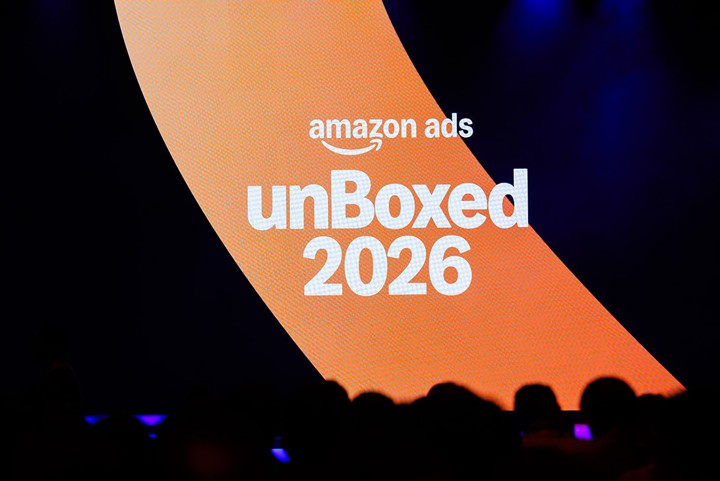
Amazon used unBoxed 2026 to make some bold announcements. As a trusted Amazon Ads agency partner, Stackline had early access to closed betas for most of these announcements before unBoxed. Our retail media team identified the five that matter most for brands heading into Q4 and 2027.
[01] Amazon Ads Agent: faster builds, bigger decisions
Amazon merged its DSP and Ads Console into Amazon Ads Agent, one platform for three campaign types: sponsored ads, Full-Funnel Campaigns and DVA+, a new campaign type that buys display, video and audio ads together. Accounts have already moved to Ads Agent with historical data intact, while search and DSP accounts stay separate for now and can be linked through an Advertiser Account. A conversational layer, rolling out now, sizes audiences, forecasts reach, recommends budgets and applies campaign changes through plain-language requests.
The agent gives brands a strong starting point, particularly advertisers newer to Amazon Ads. It assembles pre-built audiences, recommends bids and frequency, and turns campaign builds around quickly. For established teams, it offers a fast daily read on where to focus and surfaces fresh ideas during campaign builds.
Those recommendations draw on Amazon's own benchmarks and peer sets and point toward Amazon spend. Competitor pricing, organic rank, category share, and whether a sales lift came from a campaign or a competitor's stock-out all sit outside the agent's view, so it cannot show brands where white space exists before they spend. Stackline's data fills in that context, helping our retail media team decide when to follow a recommendation, adjust it or override it.
The conversational tools will speed up repetitive optimization. Trade-offs like balancing product tiers, or new launches against sell-through of older inventory, still call for human judgment. As AI takes on more campaign management, strategic decision-making and incrementality measurement become the real differentiators.
What brands can do now
Before handing more execution to the agent, brands can define a clear KPI hierarchy: the objective Amazon optimizes toward, priority products and categories, acceptable efficiency ranges, inventory and profitability constraints, and which decisions stay with people. Teams can also test the tool on basic campaign builds to learn how it works.
[02] Full-Funnel Campaigns: the upper funnel opens up
Full-Funnel Campaigns combine sponsored ads, display, video and streaming TV in one AI-managed campaign and budget, now live for all US advertisers. Brands supply products, creative and budget, and Amazon's AI manages channel mix, audiences and optimization. The campaigns connect to Ads Agent for conversational reporting and analytics. Amazon reports that beta testers saw 67% higher long-term ROAS and 29% lower cost to acquire new-to-brand customers.
The format gives brands that have not activated DSP, often because of budget, an accessible way to reach shoppers across awareness, consideration and conversion. It also runs alongside existing campaigns, so testing it does not mean replacing what already works.
That simplicity comes with trade-offs. Amazon fully manages the campaigns, reporting is limited and budgets cannot be set by tactic, which matters for brands that fund awareness separately. Strong lower-funnel conversions can also carry the blended result, so our retail media team reads results alongside independent signals like branded and unbranded share, organic rank and new-to-brand acquisition. Those signals show whether spend is driving new demand or capturing existing demand, and they help set ROAS thresholds that give the AI room to work without loosening efficiency targets. Full-funnel results also take time to build, likely one to three months, so our team balances these tests against the short-term results brands still need.
What brands can do now
For now, our retail media team sees the strongest fit for smaller-budget brands that want to test upper-funnel media and are not yet running DSP. Those brands can start with a controlled test: a defined product group or share of budget, success criteria and a baseline set in advance, and a clear comparison against the current strategy. Identifying which products have the margin to support upper-funnel investment, and where in the funnel the biggest gap sits, makes the test more useful. Brands should also plan time to get comfortable with the campaign's generative creative tools.
[03] Branded Conversations: brands join the AI shopping dialogue
Branded Conversations, launching in the US in January 2027, extends Sponsored Brands prompts into multi-turn conversations in Alexa for Shopping. Brands add a Conversation Brief with their own product expertise, such as what sets a product apart, which product fits which need and what pairs well together, and Alexa draws on it to guide shoppers. Each conversation carries a sponsored label. In early Amazon testing, nearly 20% of shoppers who engaged with a Sponsored Brands prompt continued the conversation about that brand.
This format gives brands a direct role in how an AI assistant describes their products, and our retail media team sees it as a meaningful step forward in brand control over AI shopping conversations. It also tackles a familiar problem: many negative reviews and returns stem from misaligned expectations. A strong brief sets accurate expectations before purchase, which serves brands and Amazon alike, since both want shoppers who are happy with what they buy.
The brands that stand out will supply clear, consistent and differentiated product knowledge. Comparison messaging deserves particular attention, since product comparisons rank among the most common questions shoppers bring to AI tools. AI Visibility, part of Stackline's Shopper Analytics, shows which brands AI assistants mention when shoppers research a category, which helps brands decide what to emphasize. As conversations become a new path to purchase, brands will also want to measure whether they shift shopper behavior or capture demand that already existed.
What brands can do now
Brands can audit detail pages and Brand Stores, build FAQ libraries, document category-specific customer questions, strengthen product comparison messaging, and create clear content around use cases and routines. Keeping that information consistent across detail pages, Brand Stores and creative gives Alexa a reliable foundation to draw on.
[04] Review Requests: faster reviews, sharper priorities
Review Requests, launching in North America in November 2026 for products with fewer than 1,000 total ratings, invites verified buyers to rate or review a product with one tap from high-traffic pages like the Amazon homepage. Products in Amazon's testing collected about three times as many ratings and reviews per week.
Reviews drive conversion, and gathering them within Amazon's strict guidelines takes real effort, which makes an officially sanctioned channel especially valuable. Alongside Amazon Vine, Review Requests gives new launches a faster path to the review volume shoppers expect and helps products stuck below four stars build momentum.
Brands run Review Requests as an ad, so the biggest gains come from choosing the right products. Our retail media team uses Advisor, Stackline's AI-powered retail assistant, to pinpoint top-performing products with thin review coverage, where each new review carries the most weight. Brands that resolve recurring product complaints before activating the feature turn faster review velocity into a conversion advantage, not a liability.
What brands can do now
The weeks before launch are a good window to identify high-potential products with low review counts, prioritize upcoming launch products and make sure detail pages are in strong shape before activating. Benchmarking review sentiment, volume and conversion impact now sets a clear baseline for measuring results.
[05] Audience-specific Brand Store pages: personalization after the click
Brand Stores now support page variants tailored to specific audiences, replacing a single destination for every shopper. The feature is live now.
Brands already build detailed audience strategies, then send very different shoppers to the same store experience. Audience-specific pages let the message, assortment and experience continue after the click. A lapsed buyer can see a different page than a first-time category shopper, a cross-sell audience a different product story than a conquesting audience, and a loyal customer a different assortment than a new-to-brand prospect.
The value comes from deciding which audience deserves which experience, then measuring whether personalization changes behavior. Data on who buys a brand's products gives that decision a solid starting point. Paired with audience-specific landing pages off Amazon, such as those built with Stackline Pages, brands can carry a consistent experience from the first click through the Brand Store.
What brands can do now
Brands can define the three to five audiences that warrant a distinct store experience and what changes for each: messaging, featured products, education, and bundles or cross-sell. With that groundwork in place, brands can put the new pages to work right away.
Also worth watching: plain-language analytics: Amazon expanded conversational analytics to nearly 1,000 metrics and introduced the AMC SQL Generator, which turns plain-language requests into ready-to-run Amazon Marketing Cloud queries. Both lower the technical barrier to analysis. Choices like event sources, attribution windows, cohort construction and privacy thresholds still shape the answer, so the advantage shifts from writing the query to designing the right question and acting on the result.
The marketer's role is evolving
The brands that benefit most in this next era will put the time they save into strategy: setting clear objectives, building guardrails and evaluating results against independent data.
Stackline gives brands that independent view. Our retail media team helps brands set the right goals for Amazon's AI, prepare content and audiences ahead of new launches, and measure what each campaign truly delivers.