
The brands that win Prime Day don’t wait for it. They’re building audiences, mapping touchpoint sequences, and engineering conversion, weeks before the deals go live.
That advantage doesn’t come from spending more. It comes from measuring better and acting on what the data reveals. Amazon Marketing Cloud (AMC) is the tool making that possible.
With Prime Day expected in late June 2026, the window to build meaningful audience pools is open right now. This piece breaks down what AMC is, why it matters, and how forward-thinking brands structure their campaigns across the three phases that define Prime Day performance: the lead-in, the event, and the lead-out.
The lead-in period: Building your audience before the gates open
The single most important finding from recent Prime Day analysis is straightforward: shoppers exposed to a brand’s advertising during the lead-in period, and again during the event itself, convert at meaningfully higher rates than those who only see ads on event day. The overlap is the multiplier.

Tactic-specific flighting
During the lead-in period, mid- and upper-funnel tactics should carry the heavier budget weight. This means consideration display targeting in-category, in-market shoppers; CTV and Prime Video awareness campaigns; and reaching qualified audiences at scale before intent peaks.
As event days approach, the budget mix shifts. Mid- and upper-funnel spend pulls back, and investment rotates toward conversion-focused tactics: DSP retargeting, sponsored ads, and bid boost strategies. The reach has been built. Now it’s time to close.
When to start
The lead-in timing question isn’t universal, it’s category-specific. Stackline’s Atlas platform gives brands direct visibility into category traffic trends, making it possible to look back at the past two to three years and identify exactly when category search volume begins trending upward ahead of Prime Day. For most categories, that signal appears two to three weeks before the event.
Building the AMC audience for event day
Throughout the lead-in period, AMC captures every user exposed to brand campaigns across DSP and sponsored ads who has not yet converted. That exposure data becomes the foundation for event-day targeting. Brands can build AMC Audiences from this pool and activate them on both sides:
- On DSP, those audiences are targeted directly to increase touchpoint frequency as event day begins
- On sponsored ads, the audiences are added to campaigns with bid boost adjustments — so when those shoppers search during the event, the brand earns prioritized placement
The lead-in period isn’t preamble. It’s infrastructure.
Event days: Making every touchpoint count
Prime Day 2026 is expected to follow the four-day format Amazon introduced in 2025. Four days means more inventory, more competition, and more opportunity for brands that arrive prepared.
On event days, the full media mix works in concert, and the channel with the highest reach doesn’t necessarily deliver the highest return. Stackline’s AMC analysis across a recent tentpole event breaks down exactly how each ad type contributed across three dimensions: unique reach, sales contribution, and new-to-brand rate.
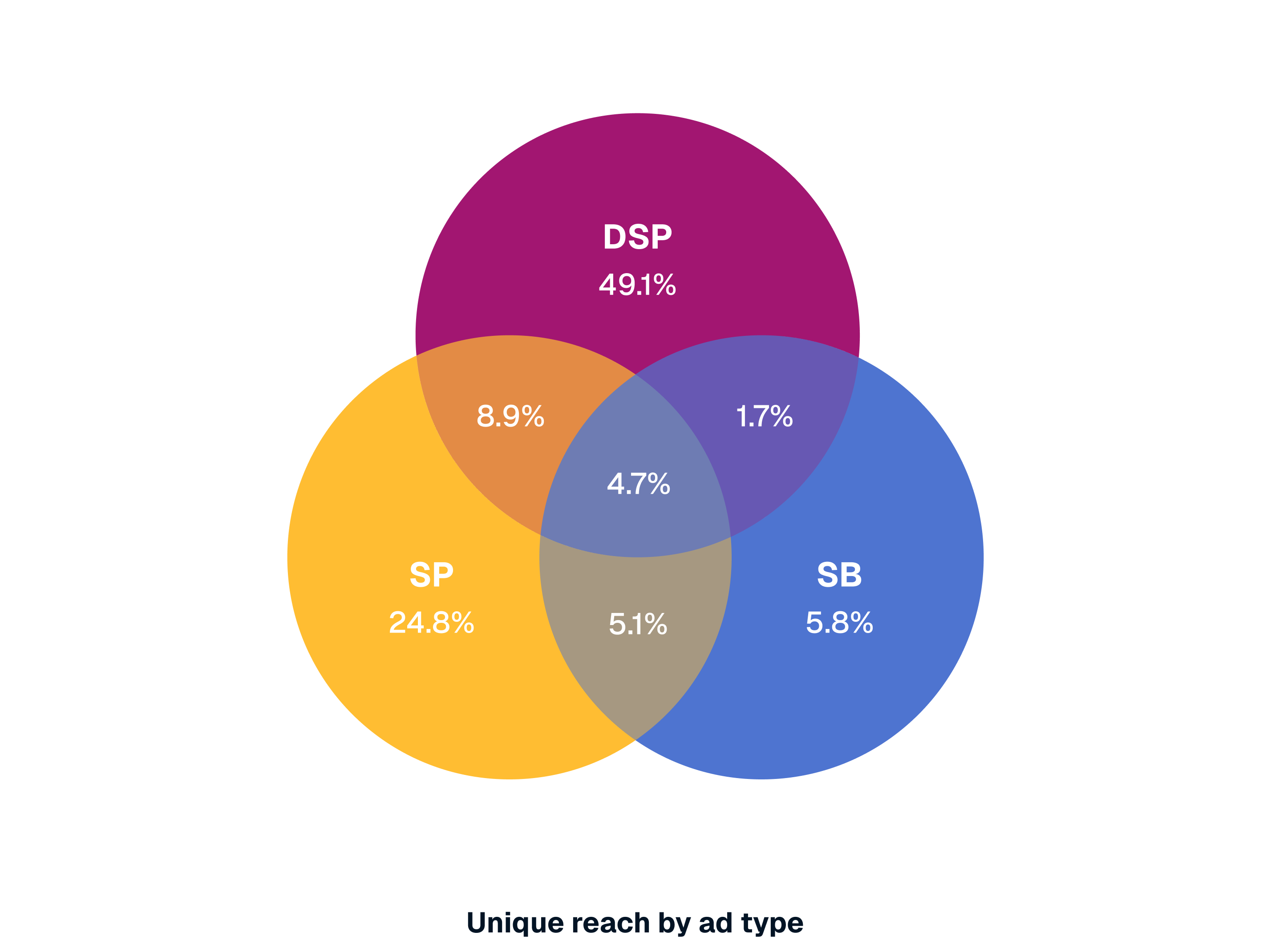
Unique reach - DSP anchored the audience, reaching nearly half of all shoppers on its own
DSP alone accounted for 49.1% of unique reach. SP added 24.8% and SB 5.8%, with meaningful overlap where ad types combined to reach the same shoppers across multiple touchpoints. The reach picture sets the stage but reach alone doesn’t tell the performance story.
Sales contribution – when channels align, conversion follows
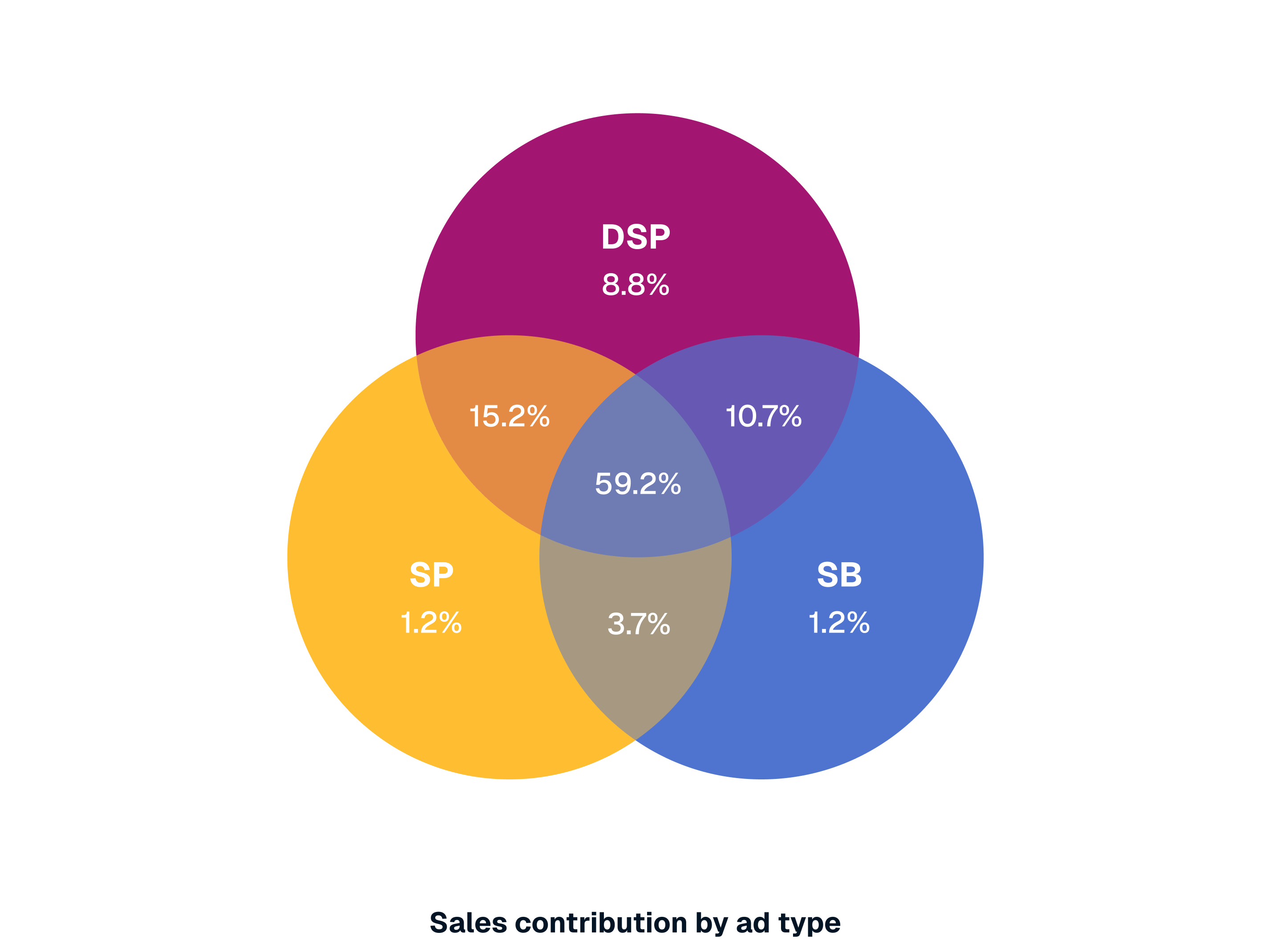
DSP alone drove just 8.8% of sales in isolation. But where all three ad types converged, the shoppers reached by DSP, SP, and SB across multiple touchpoints, 59.2% of total sales were generated. SP and SB contributed 1.2% each on their own. No single channel closes the deal. The revenue lives in the overlap.
New-to-brand rate – overlap doesn’t just convert, it acquires
Shoppers exposed to all three ad types converted as new customers at a 77.7% rate, the highest of any segment. Even DSP in isolation drove a 67.5% NTB rate, nearly double SP’s 38.4%, confirming its role as a customer acquisition engine, not just a reach driver. For brands focused on growing their customer base, the NTB data makes the case for full-funnel investment on its own.

The AMC audiences built during the lead-in period are what make this synergy possible on event day:
- DSP campaigns target non-purchaser, lead-in-exposed audiences to extend touchpoint frequency
- Sponsored ad campaigns apply bid boosts to those same audiences, prioritizing high-value, already-engaged shoppers when they search during the event
- Creative messaging is tailored to audience segment: awareness-stage users see brand-building creative; high-intent, previously-exposed shoppers see conversion-focused assets
The brands that feel like they “win” Prime Day are usually the ones who engineered the conditions for that outcome weeks earlier.
The lead-out period: Extending value beyond the event
The Prime Day window closes. The audience it created doesn’t.
The lead-out period is where brands turn a transactional event into durable customer value, and where AMC’s audience segmentation capabilities pay the largest long-term dividends.
Stackline's Prime Day 2025 analysis found that full-funnel exposure across all three phases — Lead Up, Prime Day, and Lead Out — drove purchase rates 119% higher than Prime Day-only exposure and 138% higher than Lead Out-only. Brands that showed up for the event but skipped the surrounding phases left more than half their conversion potential on the table.
Retargeting non-converters
Not everyone exposed during the lead-in or event days will purchase. Some viewed product detail pages and left. Some went to a competitor. AMC enables brands to isolate these users by segment, those who came through the lead-in versus those who appeared only during the event, and re-engage them with specific messaging in the days that follow.
Subscribe & Save activation
For brands with subscribe & save programs, first-time buyers from the event represent a high-value conversion target. AMC can identify these buyers specifically, enabling tailored creative and CTA sequences designed to move them from one-time purchase to recurring subscription, a different message from standard retargeting, and a meaningfully different outcome.
Extending long-term value
The most sophisticated lead-out strategy segments Prime Day buyers by purchase history and models re-engagement timing against known repurchase cycles. A brand that knows its typical customer repurchases around 23 days after initial purchase can build AMC audiences that activate at day 20, serving precision-timed messaging to the right shoppers at exactly the right moment.
This three-phase lead-out approach, short-term retargeting, subscription conversion, and long-term repurchase cycling, is what separates brands that treat Prime Day as a revenue spike from those that treat it as a customer acquisition engine.
Measurement: Building the queries that prove the full picture
AMC’s measurement capabilities fall into two categories that serve different time horizons, and together, they build a complete picture of what Prime Day actually delivered.
The Tentpole overlap report (short-term)
The most foundational AMC analysis for any tentpole event is the overlap report. This query isolates the lead-in, event-day, and lead-out date windows and measures reach and conversion across each period, segmented by ad type — CTV, DSP, sponsored products, sponsored brands.
The core question it answers: did lead-in exposure actually lift event-day conversion rates, and by how much? The answer benchmarks future planning. Brands that run this analysis after each Prime Day arrive at the next one with sharper flighting decisions, better audience logic, and higher confidence in their budget allocation.
This is one of the few AMC reports that doesn’t require custom SQL. Amazon provides templated queries for tentpole overlap analysis.
Path-to-conversion queries (long-term)
Standard Amazon attribution gives last-click credit. AMC gives the full story.
Path-to-conversion queries reveal the sequence of ad exposures that preceded each purchase, and in doing so, surface the actual role that upper-funnel media plays in driving revenue. CTV is the clearest example: a shopper might see a Prime Video ad, then a DSP retargeting unit, then a sponsored product before converting. Under last-click, sponsored products gets the credit. Under AMC path analysis, the CTV exposure that started the journey gets its rightful value.
For brands investing in CTV and upper-funnel awareness, this measurement is essential. Purchase cycles for upper-funnel-sourced shoppers are longer; the data only tells the right story when the analysis window is long enough to capture it.
Each Prime Day builds the benchmark for the next one. Brands that run these queries consistently arrive at future tentpole events with sharper flighting decisions, better audience logic, and a clearer picture of what actually drives revenue.
The Stackline advantage: Data, activation, and intelligence in one place
AMC is powerful. The brands getting the most from it pair AMC data with the broader intelligence and tooling that informs every decision, from when to start spending to how to structure the campaign architecture.
Stackline’s Atlas platform gives brands direct visibility into category-level traffic trends, making lead-in and lead-out timing decisions data-driven rather than intuitive. Instead of guessing when shoppers start moving toward Prime Day, brands can see exactly when the signal starts to build and calibrate their investment accordingly.
As Stackline’s Ad Manager platform continues to evolve, the integration of AMC data, Atlas category intelligence, and Advisor will make this kind of tentpole planning faster and more precise, enabling a brand’s advertising team to ask, in plain language, when their category historically sees traffic lift ahead of Prime Day and get an answer in seconds rather than hours.
Prime Day 2026 is coming. The brands that treat the weeks before it as the real event, the period where audiences are built, paths are mapped, and conversion logic is engineered, are the ones that win when the deals go live.