
Consumers are increasingly turning to AI to guide their purchases. They're asking ChatGPT which coffee to buy. They're letting AI assistants narrow down TV options before they ever visit a retailer. The shelf is shifting, and it's shifting fast.
But here's what most brands don't know: the brands AI recommends don't always match the brands consumers actually buy. High traffic, high share brands are frequently underrepresented. Smaller or premium brands are amplified far beyond their organic footprint. The AI competitive set looks nothing like the one consumers are shopping.
The question every brand needs to answer: Is AI fairly representing us relative to our traditional market position, and if not, what are we going to do about it?
To answer that question, Stackline built the AI Visibility Fair Share Framework, a way to compare a brand's AI impression share directly against its organic traffic share, revealing whether AI is amplifying, accurately reflecting, or overlooking a brand in the moments that matter most.
How the framework works
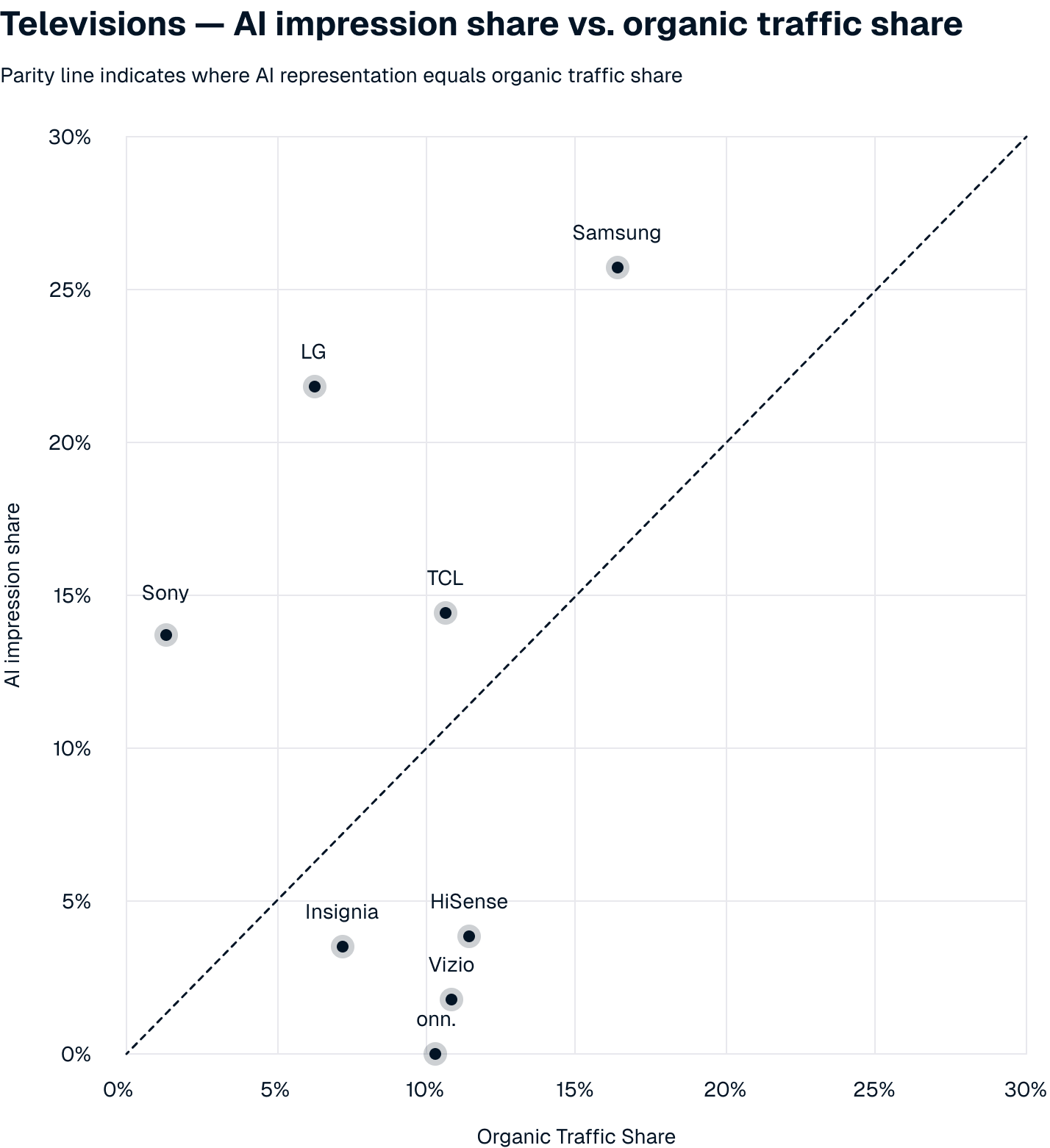
The framework plots brands on a two-axis chart: organic traffic share on the x-axis, AI impression share on the y-axis. A parity line runs diagonally. Brands on it are represented in AI exactly as their market share predicts. Brands above the line are over-represented. Brands below it are being left behind.
The data draws on two Stackline datasets: Shopper Analytics AI Visibility, which tracks brand mentions and recommendations across AI platforms, and Atlas Organic Traffic, which reflects consumer search and discovery behavior across Amazon, Walmart, and Target.
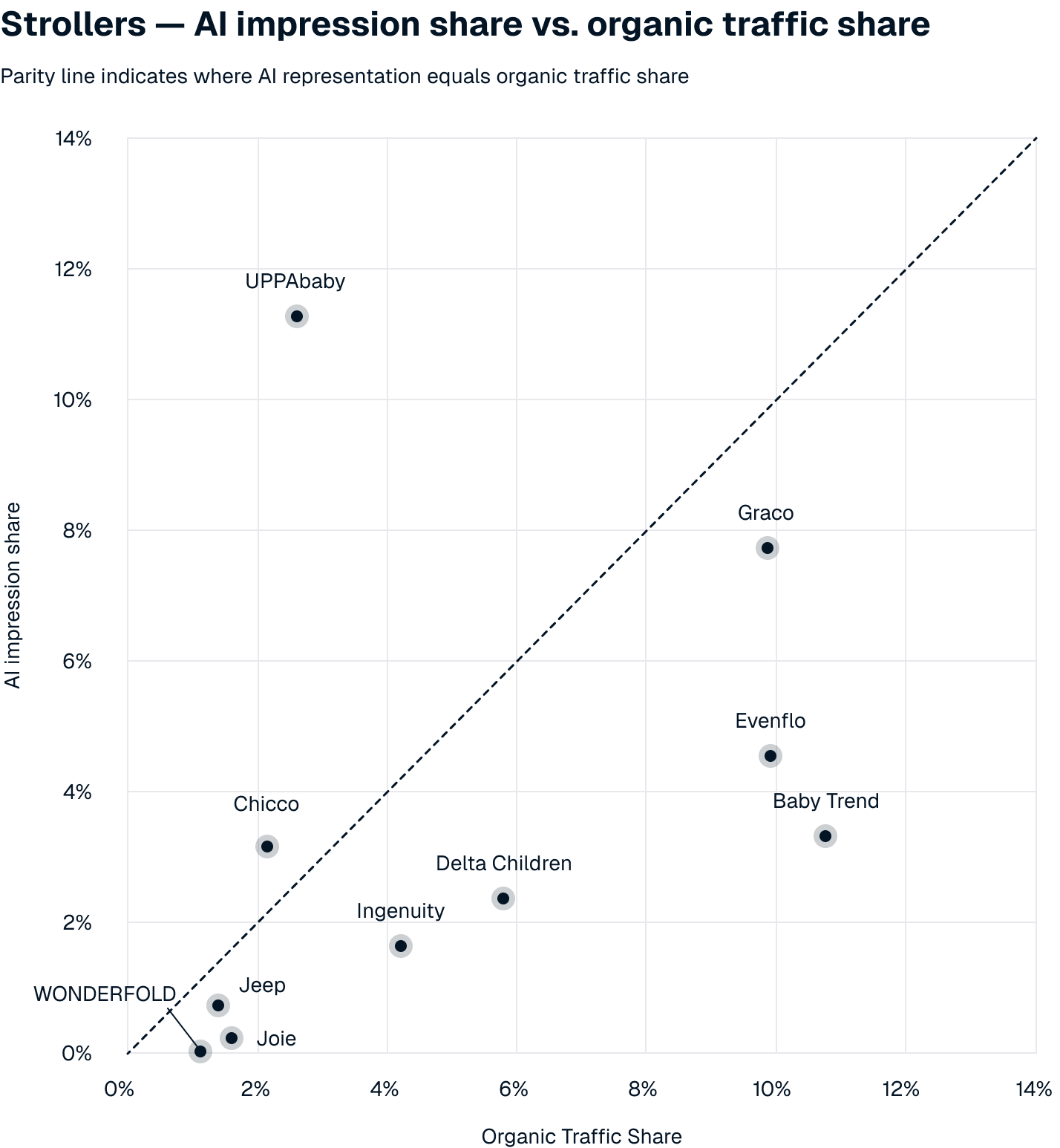
The stroller category makes the dynamic starkly clear. Graco, Evenflo, and Baby Trend collectively dominate organic traffic — each capturing between 10% and 11% — yet all three fall well below the parity line in AI. UPPAbaby, by contrast, holds just 2.8% organic traffic share but commands 11.3% of AI impressions, a gap of +8.5 percentage points.
In a category where parents are increasingly turning to AI for buying guidance, UPPAbaby is showing up where it counts most.
The signal gap: why AI overlooks traffic leaders
Strong organic traffic doesn't automatically translate into AI visibility. AI platforms don't read traffic data, they read content. And brands that dominate online search often haven't built the digital content ecosystem that AI systems learn from and reference.
There are four signals that consistently drive AI visibility:
- Content depth: Rich product content gives AI more to work with when generating recommendations.
- Editorial authority: Reviews, comparison guides, and specialist publications signal credibility that AI treats as a trust proxy.
- Structured data: Consistently structured and widely syndicated product information is more likely to surface in AI outputs.
- Conversations: High engagement in forums, Q&As and social content creates a density of brand signal that AI learns from.
Brands underperforming their organic traffic share in AI visibility have a signal gap — strong retail and search execution that has not been translated into the content ecosystem that AI reads. Closing that gap is a content and authority problem, not a sales one.
Three positions. Three responses.
The Fair Share Framework reveals that brands don't fall on a single spectrum, they occupy one of three distinct positions, each requiring a different strategic response.
Reinforcement: Same brands, same order.
AI visibility mirrors market position. Brands should defend and optimize — monitor competitive positioning and make incremental improvements to hold their spot or break out of the pack.
Amplification: Same brands, different order.
AI favors certain brands above the parity line. Amplified brands should decode and replicate their signals. Competitors of amplified brands should reverse engineer what's driving the advantage.
Reshuffling: Different brands, different order.
AI changes the competitive set entirely. Under-represented leaders must close the signal gap. Smaller brands should exploit this window and convert visibility to sales and brand equity.
Amplification in action: coffee
Coffee tells the amplification story clearly. Lavazza holds just 2.7% organic traffic share but captures 10.3% of AI impressions — a gap of +7.6 percentage points. Nespresso and Stumptown Coffee Roasters also sit above the parity line. These are brands built around origin stories, brewing culture, and the kind of editorial content that coffee enthusiasts produce in abundance. AI reads that signal ecosystem and responds accordingly.
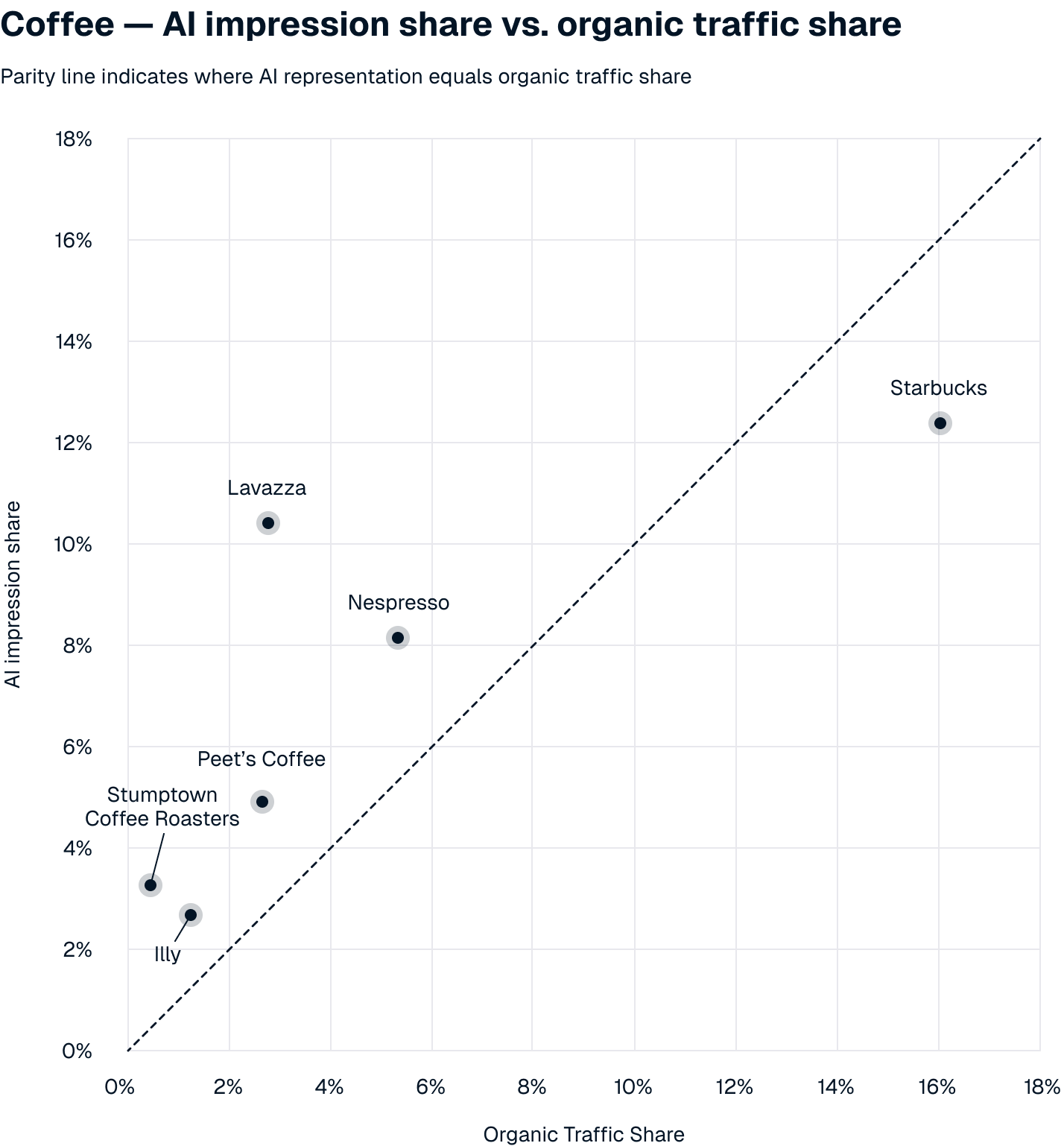
Starbucks offers an important nuance. It leads the category in both organic traffic at 16% and AI impression share at 12.3%, no other brand comes close in absolute terms. But relative to its traffic dominance, it sits just below the parity line, meaning AI is representing it at a slightly lower rate than its search footprint would predict.
The more important signal is what's happening below them: brands like Lavazza are punching well above their organic weight, making the AI competitive set far more crowded at the top than traffic share alone would suggest.
Reshuffling in action: televisions
Televisions show a more dramatic reshuffling. Samsung and LG capture 25.6% and 22.2% AI impression share respectively — well above their organic traffic positions. Sony, with just 1.4% organic traffic share, commands 13.9% of AI impressions. On the other side, HiSense, Vizio, and onn. collectively drive over 32% of organic traffic but together account for just 5% of AI impressions. Consumers asking an AI assistant which TV to buy are getting a very different answer than the one reflected by what's actually in living rooms across the country.
From diagnosis to action
The Fair Share Framework does more than show you where you stand. It maps how the search shelf has been reordered by AI, quantifies the gap between where your brand ranks in organic discovery and where it shows up when consumers ask AI for a recommendation, and connects that gap to a clear set of strategic priorities.
The three positions — reinforcement, amplification, and reshuffling — aren't just descriptions. They're starting points for action. Whether that means defending a visibility advantage before competitors close in, closing a signal gap that's costing you AI presence you've already earned in search, or exploiting a window of visibility that smaller brands can convert into lasting brand equity.
AI has changed what it means to be findable. The brands that understand their position in this new landscape, and move on it, will have a meaningful advantage over those still optimizing for a shelf that no longer tells the whole story.
AI doesn't reward the brands that get the most traffic. It rewards the brands that built the best content ecosystem. That's a gap every brand can close — but only if they know where they stand.