
Shoppers don't follow a single path to purchase. They search on Amazon, Walmart, and Target. They ask ChatGPT, Amazon Alexa, and other AI platforms to help them research, compare, and decide.
When interest in a category or trend accelerates, it shows up across dozens of related terms. Different phrasing, different questions, different entry points into the same underlying need. Tracking individual keywords captures fragments of that behavior, and monitoring AI platforms in isolation captures another. Topics connects both into a single view of category demand.
Topics is a capability within our Shopper Analytics platform that allows brands to group keywords and shopping questions into defined interest areas, then measure the volume, velocity, and competitive dynamics behind each one. Where individual keyword tracking shows snapshots, Topics shows the full picture.
Two views into consumer demand
Topics surfaces two distinct layers of consumer behavior: traditional retail search and AI-driven shopping questions.
Search interests: measure how much volume a topic commands across retailers, how that volume breaks down by brand and keyword, what share remains unbranded, and how quickly the topic's language is expanding.
AI visibility: track the questions consumers ask across AI platforms and the answers AI serves in response, including which brands and content are showing up, how question volume is growing, which platforms drive it, and how much of that demand is unclaimed.
Together, these views show not just what consumers are searching, but how they're researching, and where brands can insert themselves into the conversation.
Reading the signal
Consider how a brand in the skincare category might use Topics to track the rise of peptide skincare. Rather than piecing together data from multiple sources, Topics surfaces everything in one place, and the analysis follows a clear sequence. Here's what it looks like in practice.
[01] Define the topic
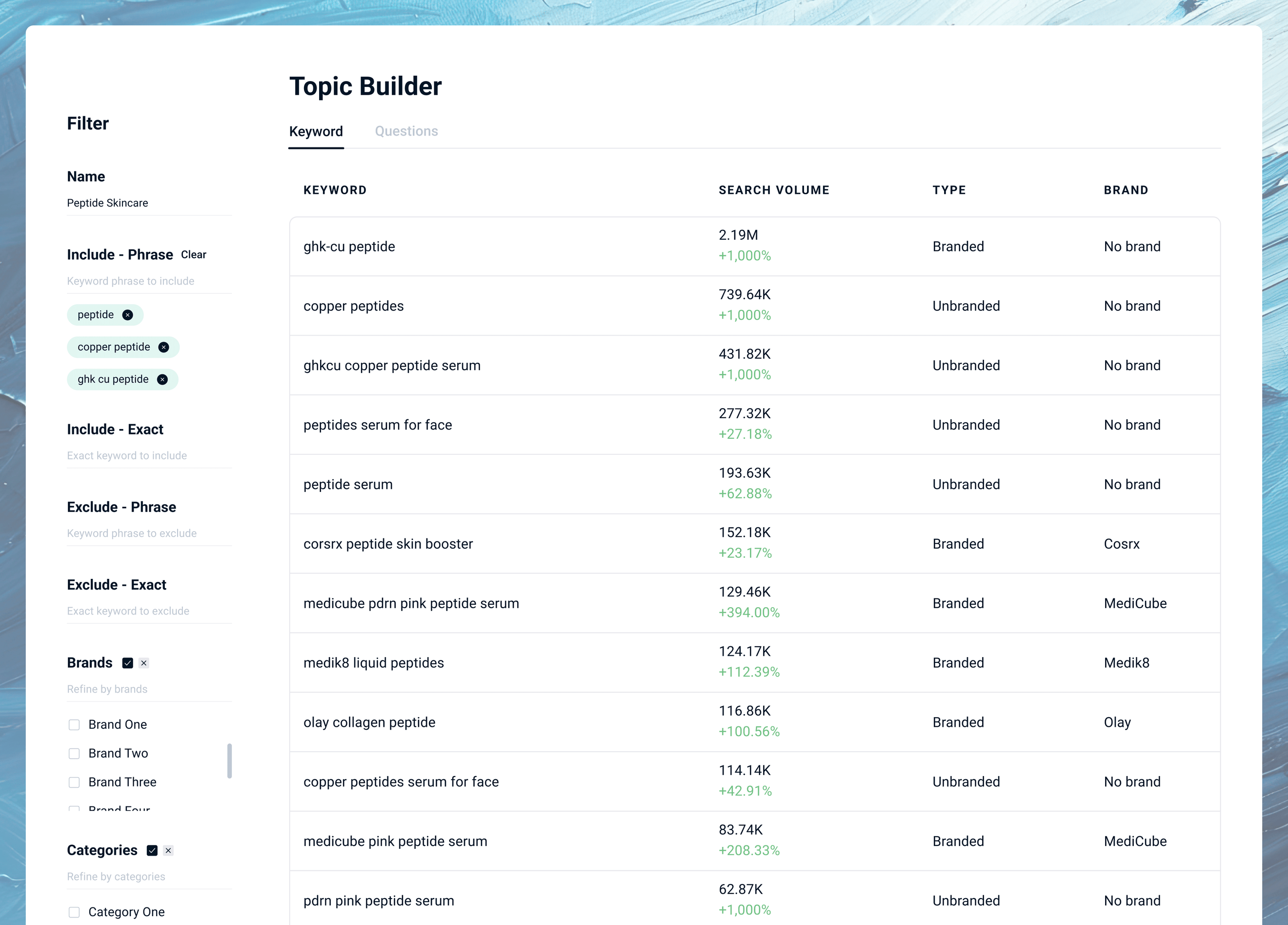
Topics allows brands to build an interest area by grouping related keywords and shopping questions into a single view. The platform then measures demand across both retail search and AI platforms, so nothing gets missed.
For peptide skincare, that means capturing a cluster of related terms — "copper peptide," "ghk-cu," "collagen peptide" — alongside question-based queries like "Can you recommend creams or serums with GHK-Cu for skin rejuvenation?", "Which copper peptide products are best for skin care?", and "Which peptide serums are most effective for anti-aging?" Once the topic is defined, Topics measure the full weight of consumer demand behind it.
[02] Measure the momentum
Search volume is the first indicator of whether a trend has real traction. A steep year-over-year increase signals that consumer interest is accelerating, not just present. AI question volume provides a second data point. When both channels are growing simultaneously, it's a strong signal that interest has reached a tipping point across the full purchase journey.
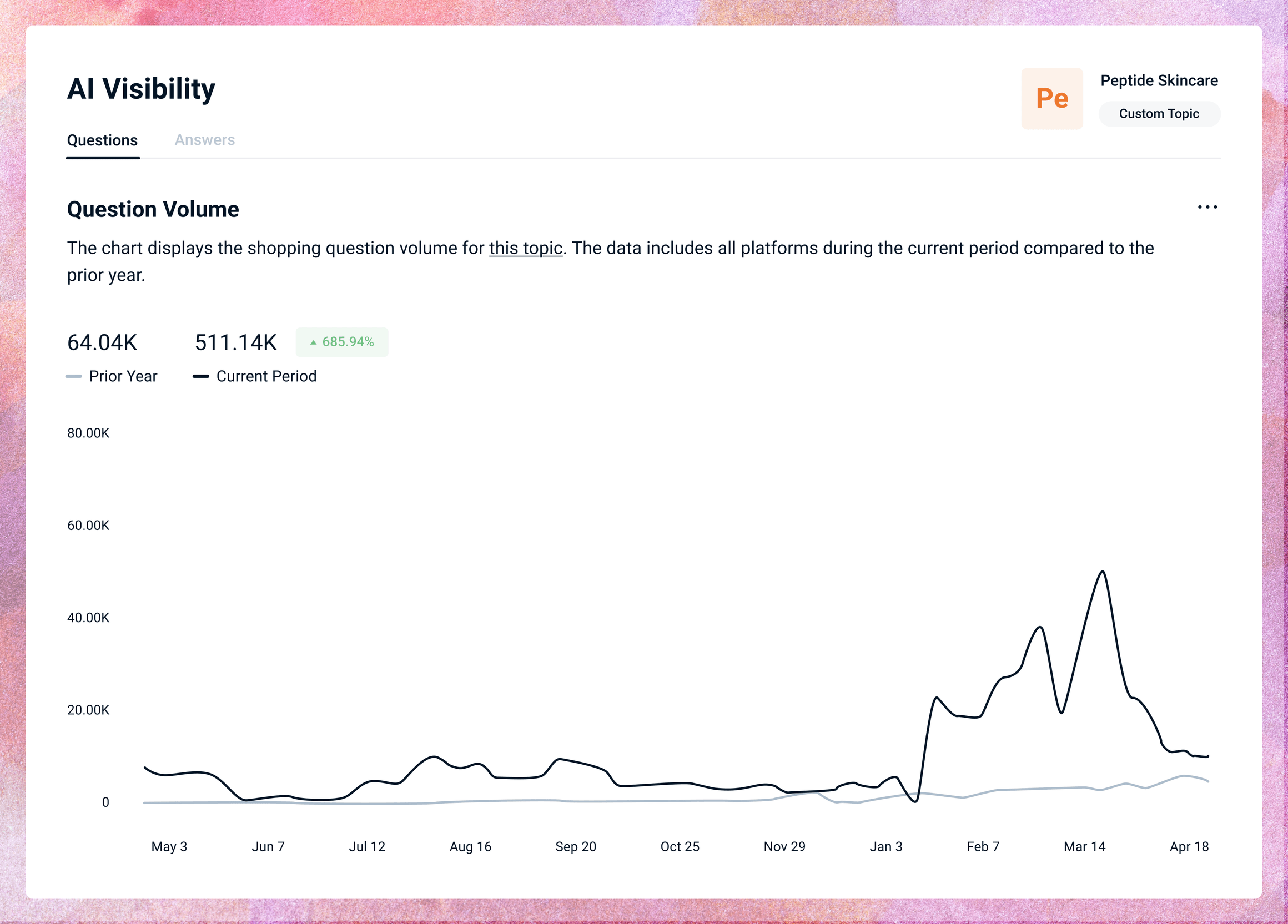
For peptide skincare, search volume reached almost 10 million over the last 52 weeks, up 213% from the prior year. AI question volume tells the same story: consumers asked over 500K questions about this topic across AI platforms in the same period, up 686, with the majority of that volume concentrated in the last few months, suggesting interest is accelerating. Brands that recognize that inflection early are the ones that define the category rather than compete in it.
[03] Track the trajectory
Keyword count, the number of unique terms consumers use to search a topic, reveals whether a trend is still forming or has already matured. A rapidly expanding keyword count means shoppers are still exploring, trying different phrasings and approaching the topic from new angles. On AI platforms, the same signal shows up in how question types diversify over time, from broad awareness questions to more specific comparisons and recommendations.
For peptide skincare, the number of unique search terms grew from 146 to 239, a 64% increase. The types of AI questions are expanding in parallel, from broad ingredient benefit questions to specific product comparisons and formulation questions, reflecting a trend still taking shape.
[04] Size the opportunity
Unbranded search share measures what percentage of searches for a topic don't include a specific brand name. A high unbranded share means consumers are actively shopping the category but haven't committed to a brand, the clearest signal that there's still room to win consideration. The same metric on AI platforms shows how much of the question-driven conversation remains open to influence.
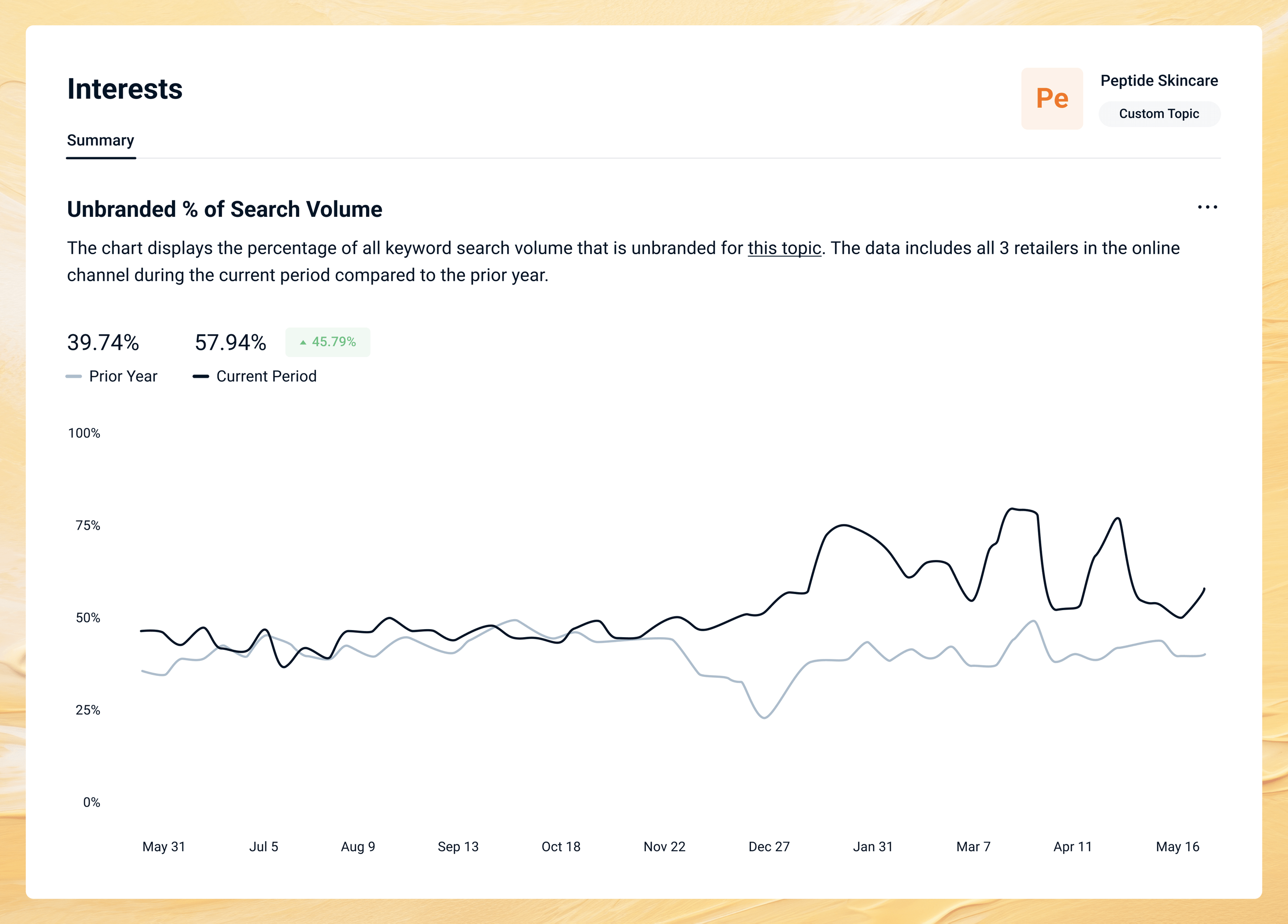
For peptide skincare, 62% of all searches remain unbranded, meaning the majority of demand in this category hasn't committed to a brand yet. Consumers know what they want. They just haven't decided who to buy it from.
[05] Own the answer
AI impressions measure how often a brand, product, or piece of content appears in answers to shopping questions on ChatGPT, Amazon Alexa, and other AI platforms. Unlike keyword search, this metric is specific to AI platforms, it shows not just what consumers are asking, but what AI is serving in response and who is showing up consistently in those answers. Tracking impressions by brand, destination type, and content format shows not just who is winning, but how.
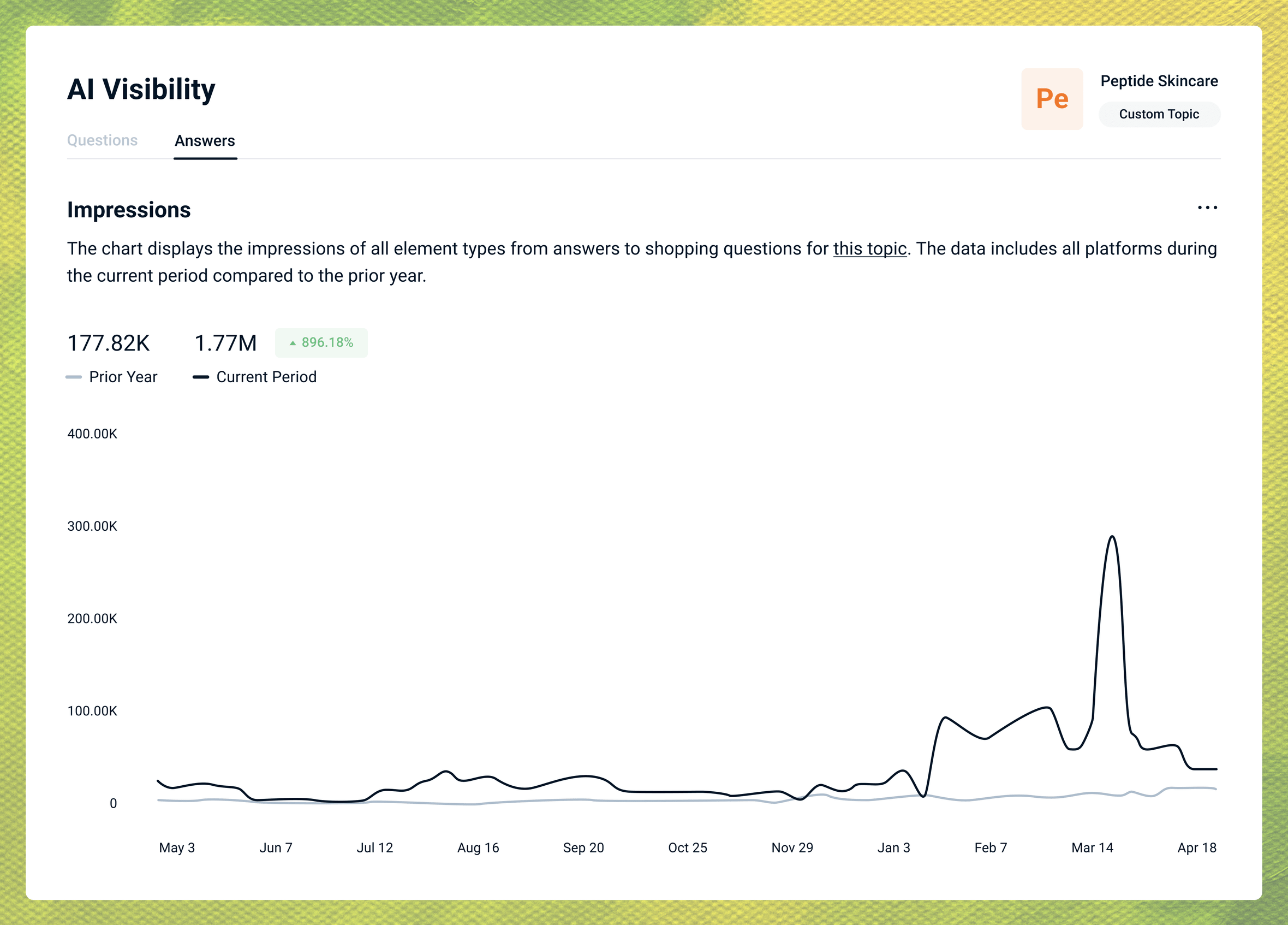
For peptide skincare, AI platforms generated 1.77 million impressions over the last 52 weeks, up 896% from the prior year. Product pages account for the majority of where those impressions land, but editorial content is growing fast, signaling that informational content is increasingly part of how AI platforms answer shopping questions.
For brands not yet appearing in these answers, that's the gap. For brands that are, it's a benchmark, and a signal of where to invest to maintain or grow that presence.
Taken together, the search and AI data describe the same moment from two angles: a trend accelerating in real time, with consumer attention outpacing brand presence. That's the window Topics makes visible.
For a brand in the skincare category deciding where to invest in content, advertising, or product development, this isn't trend watching. It's a data-backed case for action. That's what Topics is built for, not just to surface data, but to help brands ask the right questions about their category and act on the answers.
Where to find Topics
Topics sit alongside Categories, Segments, and Audiences within Shopper Analytics. Brands can move fluidly between macro-level category performance and granular topic analysis, connecting interest signals to the broader retail data that drives decision-making.
The platform is built around the idea that consumer behavior doesn't live in silos, and neither should the tools brands use to measure it. Topics is one more layer of intelligence in a system designed to give brands complete visibility into how and why shoppers buy.