
AI Visibility opportunities reveals where products are missing from high-value AI-generated recommendations, quantifying the impact of missed visibility and helping teams prioritize the opportunities that matter most.
AI is rapidly becoming a primary entry point into the shopping journey. Shoppers are asking questions directly within AI platforms like ChatGPT and Amazon Rufus, and receiving curated recommendations instead of browsing traditional results. In fact, recent Stackline data highlights how quickly this behavior is accelerating. U.S. consumers are already asking more than 179 million shopping-related questions on ChatGPT and Amazon Rufus every week, and conversational shopping is only becoming more embedded into product discovery. As question volume grows, the opportunity (and risk) for brands grows alongside it.
Identify opportunities, quantify impact, prioritize optimization
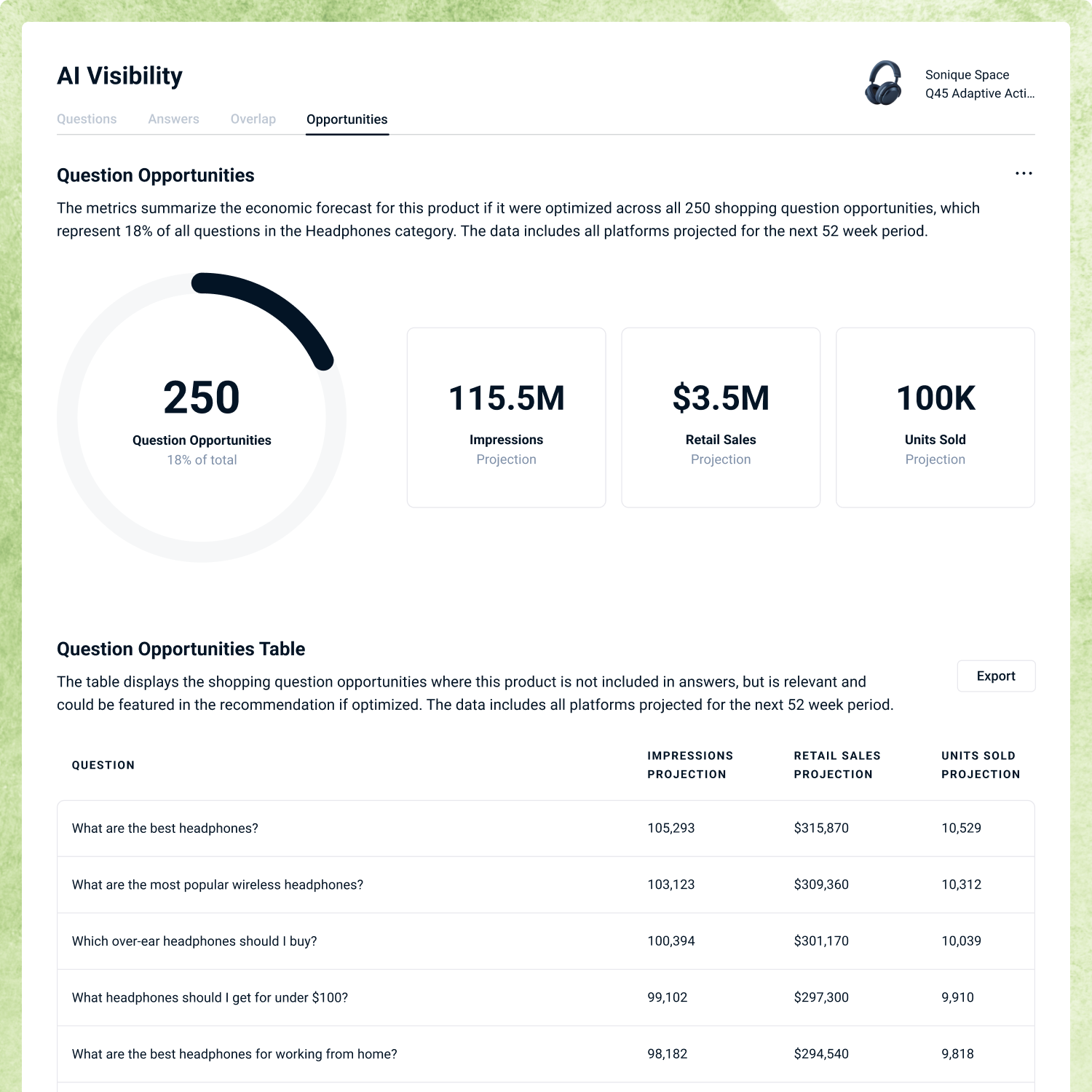
AI Visibility Opportunities identifies the high-intent questions where products are relevant but not currently recommended by shopping agents, maps them to the product catalog, and quantifies the potential impact of each missed recommendation.
For example, a headphones brand might uncover missed opportunities for a product across questions such as:
- What are the most popular wireless headphones?
- What are the best headphones for working from home?
- Which over-ear headphones have the best noise cancellation?
These high-value questions represent critical moments where recommendations drive discovery and purchase decisions. AI Visibility Opportunities then translates these missed opportunities into measurable metrics, including:
- Question Opportunities: the number of specific target questions where a product is relevant, but not featured or recommended by ChatGPT or Amazon Rufus
- Projected Impressions: the total number of potential impressions a product could receive if optimized and recommended for each target shopping question
- Projected Retail Sales: the total sales a product is projected to earn if it was optimized and recommended for each target shopping question
For a single product, this could mean hundreds of question opportunities, representing millions of potential impressions and retail sales if optimized across those opportunities either through content generation or LLM-readable pages.
On average, brands are identifying roughly $87K in incremental sales opportunities per product, underscoring the scale of untapped value in AI-generated recommendations.
Opportunities are then ranked by projected business value, helping teams focus on the most impactful actions. At the product level, teams can see the exact questions where products are missing, the projected performance tied to each opportunity, competitive visibility dynamics, and priority pathways for optimization. This structured view ensures effort is concentrated where it will drive the greatest growth.
Extend digital shelf strategy into AI discovery
AI Visibility Opportunities builds on traditional digital shelf workflows by extending visibility into AI-driven discovery environments. Stackline’s research shows how quickly conversational shopping can scale, making recommendation visibility an essential part of modern digital shelf strategy. By combining question intelligence, competitive insights, and projected outcomes, AI Visibility Opportunities helps brands understand where they are visible, where they are missing, and how to prioritize opportunities with the greatest impact.